The Stories That Come With You
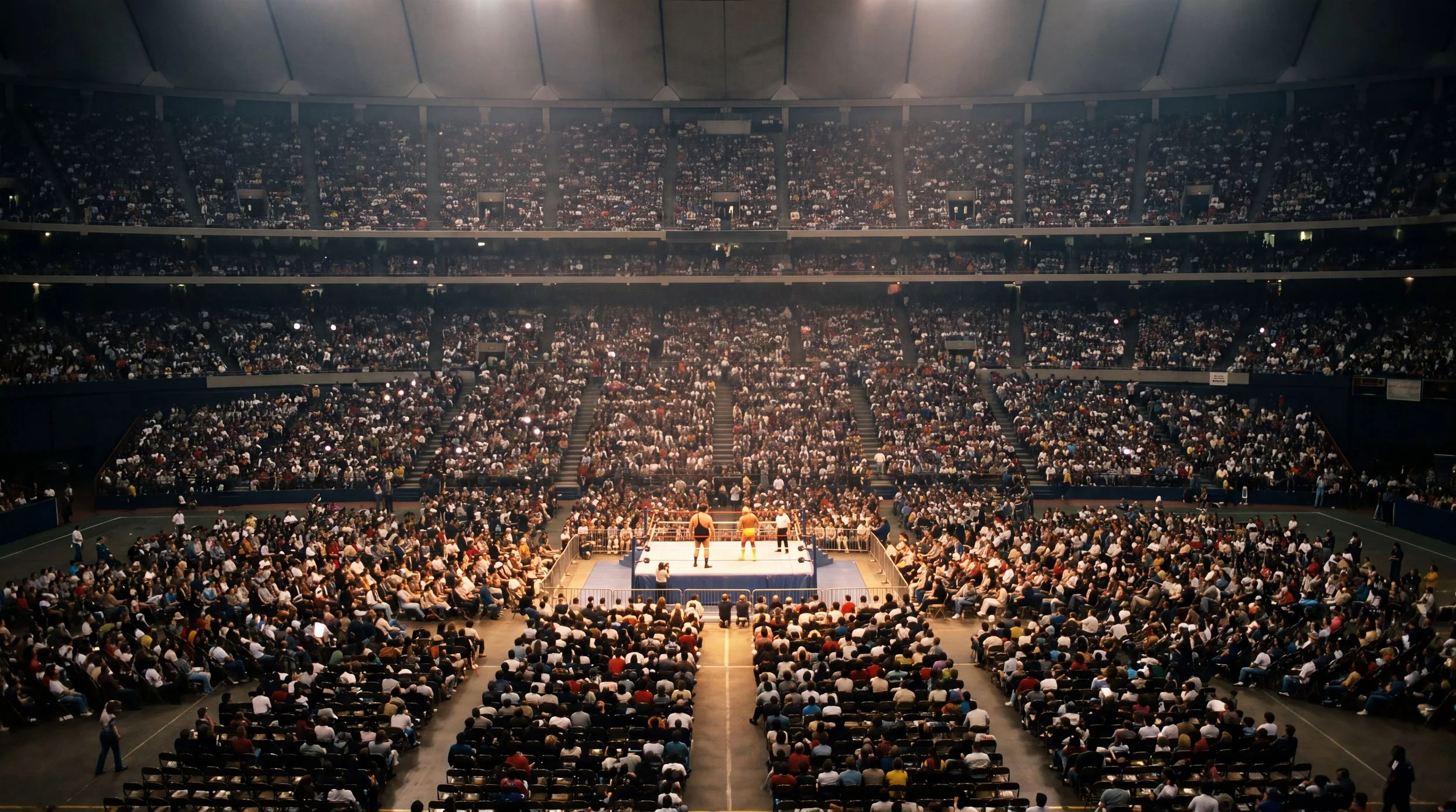
I have loved wrestling since I was a kid. An early childhood memory of mine is the feud between Hulk Hogan and Andre the Giant, a story that built toward WrestleMania III at the Pontiac Silverdome in Pontiac, Michigan, which happens to be my home state.
The show took place on March 29, 1987, and it opened with Aretha Franklin singing "America the Beautiful." Andre came into the main event billed as undefeated for fifteen years, and Hogan, the champion, had to stand across the ring from him. When it was over, Hogan lifted the Giant, slammed him to the mat, and kept his title. The company announced a crowd of 93,173, a number industry observers have since put closer to 78,000, and one account says the announced figure was scribbled on a cocktail napkin backstage. The larger number is the one that stayed in the telling, the way the best parts of a story do.
The night was a gamble for the company that staged it, and its success pointed that company toward billions in future revenue. Hogan told The Detroit News in 2024 that the night put the company on the map, and the paper described the slam as wrestling's new guard taking down its old guard.
Music was in that building too, and it came into my life like a freight train. I spent my late teens and early twenties in it, and my love for it has stayed with me ever since. So, when I think about the things I love, wrestling and music sit together.
That is why I wanted to write about Billy Corgan. In my eyes, he is a brilliant singer, songwriter, and businessman, and he has all three of those same loves. When Hogan slammed Andre, Corgan had just turned twenty. The following year he formed the Smashing Pumpkins in Chicago, and he has been the band's primary songwriter ever since, with songs like "Cherub Rock," "Today," "Disarm," and "1979." Time magazine named the band's album Mellon Collie and the Infinite Sadness the best of 1995, and the band's latest album, Aghori Mhori Mei, arrived in 2024 as its 40th anniversary comes into view.
Wrestling reached him early, too. He fell in love with it as a boy in Chicago, watching Saturday morning broadcasts with his great-grandparents, who had emigrated from Belgium. He founded Resistance Pro Wrestling in 2011, joined the creative team at TNA five years later, and bought the National Wrestling Alliance in 2017, a promotion that launched the careers of wrestlers from Lou Thesz to Ric Flair and Dusty Rhodes. By his own account, many people thought its best days were behind it. He has spent the years since rebuilding its following, and in 2026 its flagship show, NWA Powerrr, landed its first broadcast television deal under his ownership.
Not everyone around him understood how the pieces fit together. In 2000, he appeared on an ECW show and cracked a guitar over a wrestler's head, and he has said fellow musicians looked down on his involvement. He has said he wishes the music fans cared more about wrestling, and in 2024 he described his time as roughly sixty percent music and forty percent wrestling.
A third area I can connect with him on is his long-standing focus on faith. In a 2013 interview, he said he spent much of his musical career exploring suffering and wanted to turn his attention to God; he once told Rolling Stone that God is "the third rail of rock and roll." On September 23 of this year, on his podcast The Magnificent Others, he sat down with Stryper singer Michael Sweet and said, "I'm a Christian as well." Sweet's band built its career on singing about Jesus, and Sweet told him the band probably would have been bigger. Sweet called Corgan brave and said he respects his openness about faith. Corgan said that being honest about his faith matters more to him than the possible cost to his career. He has noted that the first assumption people make when you talk about Jesus is that you are preaching, and he does not consider himself a preacher. He has also said that pushing people too hard can drive them away from faith, and when he was asked why he believes, he said it comes down to hoping for and believing in what we cannot see.
Corgan keeps all three in the same room. He says the NWA has "always been about storytelling, personality, and passion," and that description fits a wrestling match, which gives you a hero, a villain, a fall, and a comeback. It fits a song, which builds, breaks, and builds again. It fits my faith, a story whose arc has carried people for two thousand years. Each of these three carries an emotional arc, and each one earns it by telling a story with enough heart that the person on the other side feels it. That is why I still love all three, and why I believe they belong together.
The road has taken Corgan from Saturday morning television in Chicago to stadium stages, to a wrestling company, and now to a podcast conversation about Jesus. Mine started in Michigan, and the stories have come along with me through every chapter since. The places change as the years go by, and the stories that moved you first keep coming with you.
Somewhere right now, a kid is watching a wrestling match for the first time, and a story is taking hold of him. Which stories have come with you?